
Ontario Workforce Priority (OWP): What the OINP Redesign Means for Applicants
Learn what the new Ontario Workforce Priority (OWP) stream means for your immigration plans. This OINP policy analysis explains why Ontario redesigned the program, what changed, and how the new workforce-focused approach could affect future applicants.
POLICY INSIGHTS
7/5/20264 min read
A Policy Analysis
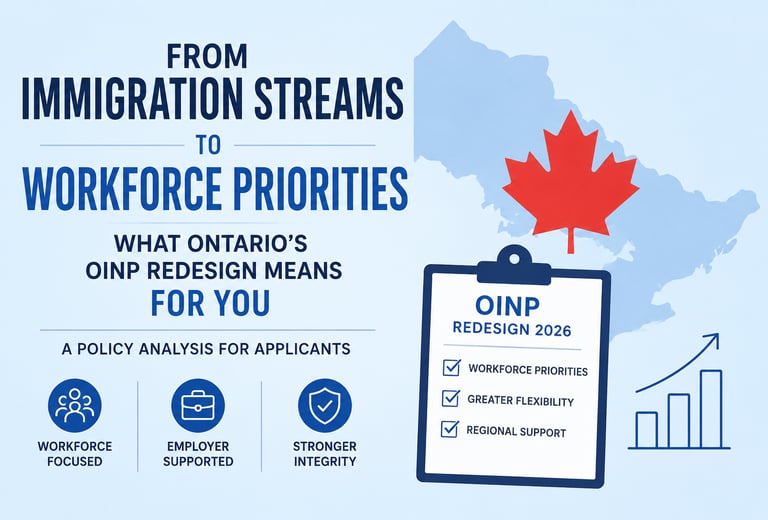
At first glance, Ontario's 2026 redesign of the Ontario Immigrant Nominee Program (OINP) looks like a administrative change, but if you look a little closer, the redesign tells a much bigger story.
The regulatory changes suggest that Ontario is rethinking not just how its immigration program is organized, but how it selects immigrants.
Taken together, the amendments to the OINP framework point toward a broader shift from organizing immigration through separate program streams to selecting immigrants based more directly on Ontario's workforce priorities. Understanding that shift helps explain not only what changed, but why and what it could mean if you're planning to immigrate to Ontario.
Why the Previous System Needed a Rethink
Over time, the OINP expanded into eight separate immigration streams, each with its own eligibility rules, application process, and target group.
While this created more pathways for applicants, it also made the program harder to navigate and more difficult for the province to manage. Applicants often had to determine which stream best matched their circumstances, while Ontario had to administer multiple programs with different rules.
The system also became less flexible. Because many eligibility requirements were set out in regulation, adapting the program to changing labour market needs often required formal regulatory amendments rather than routine program updates.
Instead of continuing to add or adjust individual streams, Ontario chose a different approach.
The redesign replaces separate streams with a unified framework built around one central question:
What type of worker does Ontario need?
What Actually Changed
The biggest change isn't simply that Ontario reduced the number of streams. It's that the province changed the way the program is organized.
Rather than separating applicants into different immigration streams, the new framework is organized around the National Occupational Classification (NOC) TEER system, which classifies occupations according to the level of training, education, experience, and responsibility they require.
That may sound like a technical change, but it reflects a different way of thinking about selection.
Under the previous model, the starting question was often:
Which immigration stream does this applicant qualify for?
Under the redesigned model, the question increasingly becomes:
What type of worker does Ontario currently need?
That shift changes the logic of the program.
The redesign also introduces several other important changes:
Greater flexibility. Ontario now has more room to adjust invitations, respond to labour market conditions, and manage application volumes within a single framework.
Regional priorities. Lower revenue thresholds for rural employers allow the province to support regional development without creating additional immigration streams.
Stronger program integrity. Faster enforcement measures and more efficient compliance procedures reflect an ongoing focus on protecting the integrity of the program.
Together, these changes suggest that Ontario is building a more adaptable immigration system—one that can evolve alongside the province's economic needs.
What Could This Mean for You?
If you're planning to immigrate to Ontario, the redesign doesn't necessarily make the program easier or harder. Instead, it changes how you should think about it.
In the past, many applicants focused on finding the immigration stream that best matched their background. A graduate looked at the graduate stream. A tradesperson considered the Skilled Trades stream. Someone with a job offer explored one of the Employer Job Offer streams.
The new framework encourages a different way of thinking.
Instead of asking, "Which stream fits me?" you may increasingly need to ask, "How does my occupation fit Ontario's workforce priorities?"
That shift has several practical implications.
Your occupation may matter more than before. Ontario now has greater flexibility to prioritize occupations as labour market needs change. Future invitation patterns may reflect current economic priorities rather than fixed stream categories.
A job offer plays a bigger role. In Phase 1, all pathways except the physician pathway require a qualifying job offer. Having employment in Ontario is now central to most applications under the new framework.
Invitation patterns may become harder to predict. A more flexible system allows Ontario to respond more quickly to changing labour market needs, but it may also make invitations less predictable. Instead of relying heavily on previous invitation rounds, applicants may need to pay closer attention to Ontario's current workforce priorities.
Keeping up with policy changes becomes more important. As Ontario introduces new pathways and adjusts its priorities, understanding the direction of the program may become just as important as understanding today's eligibility requirements.
For applicants, the redesign is more than a change in structure. It reflects a broader shift in how Ontario approaches immigrant selection.
What Should You Watch Over the Coming Months?
The June 2026 redesign is only the first phase of Ontario's broader reform. Additional streams are expected later in the year, so the full direction of the program has not yet emerged.
Here are a few developments worth watching.
How Ontario defines its workforce priorities. Will the province clearly communicate which occupations or skill levels it is targeting, or will those priorities become apparent only through invitation rounds?
The reopening of the Expression of Interest (EOI) system. The new EOI system is expected to open later in Summer 2026. How candidates are ranked and invited will provide important clues about how the redesigned program operates in practice.
Phase 2 of the redesign. Ontario has indicated that additional streams are coming. These announcements will help clarify whether the province intends to broaden eligibility or continue focusing primarily on employer-supported pathways.
For now, one thing is clear: Ontario's immigration system is entering a period of transition.
Understanding why these changes are happening, not just what the new rules are, will help you make more informed decisions as the program continues to evolve.
Ontario's new Workforce Priority (OWP) stream represents more than a program update. It signals a new approach to immigrant selection. Discover what the OINP redesign means for applicants, and contact us if you'd like to discuss your immigration strategy.
This article is intended for general information and policy discussion only. It does not constitute legal or immigration advice. Readers should consult the applicable legislation, official Ontario government publications, or a qualified immigration professional regarding their individual circumstances.
Regulated Canadian Immigration Consultant
Member #: R515705
Mapleaves Immigration Services
©2026 All rights reserved