Beyond the Ontario Workforce Priority (OWP) Framework: Understanding Phase 1 of Ontario's OINP Redesign
Understand Phase 1 of Ontario's OINP redesign and the new Ontario Workforce Priority (OWP) framework. Learn what's new, what's been enhanced, what's been carried forward, and what these changes mean for applicants and employers.
POLICY INSIGHTS
7/7/20265 min read
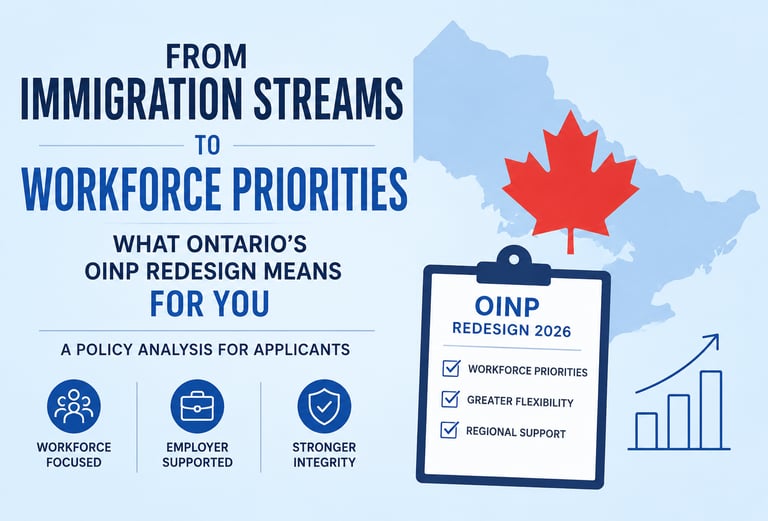
Ontario's 2026 redesign of the Ontario Immigrant Nominee Program (OINP) is one of the most significant updates to the program in recent years.
Looking for practical guidance? Read our companion article, Ontario Workforce Priority (OWP): What Applicants Need to Know Before Applying, to learn how the redesigned framework may affect your eligibility and next steps.
The most visible change is the introduction of the Ontario Workforce Priority (OWP) framework. Under the previous OINP structure, employer-driven applicants applied through separate streams such as the Foreign Worker Stream, International Student Stream, and In-Demand Skills Stream. Today, those pathways have been consolidated into three new OWP categories:
Ontario Workforce Priority – TEER 0–3
Ontario Workforce Priority – TEER 4–5
Ontario Workforce Priority – Self-employed Physician
This creates a more unified employer-driven framework, but the redesign goes much further than introducing a new stream.
The regulation contains a combination of entirely new policy features, enhancements to existing rules, and long-standing requirements that remain in place. Understanding the difference helps explain how the program has evolved—and what it could mean if you're planning to apply.
What's Actually New in Phase 1?
A Unified Ontario Workforce Priority (OWP) Framework
The Ontario Workforce Priority (OWP) framework is the most visible change.
Rather than organizing employer-driven applicants through multiple streams, Ontario now organizes employer-driven pathways primarily by TEER category and occupation. This creates a single framework that the province can manage more consistently while responding to changing labour market needs.
A unified framework may provide Ontario with greater flexibility to administer employer-driven nominations within a single program as labour market needs evolve.
What Has Been Enhanced?
A Broader TEER 4–5 Pathway
The new Ontario Workforce Priority – TEER 4–5 category replaces the former In-Demand Skills Stream, but it is more than a new name.
Previously, eligibility depended on a prescribed list of eligible occupations. Under the redesigned framework, the pathway is organized around the broader TEER 4–5 occupational category.
This does not necessarily mean every TEER 4–5 occupation will receive invitations. Ontario continues to control invitations through the Expression of Interest (EOI) system.
However, the new framework provides greater flexibility. Instead of continually updating occupation lists through regulation, Ontario can respond more efficiently to changing labour market needs while maintaining a broader occupational framework.
Revised Employer Revenue Requirements
Employer revenue requirements remain part of the program, but Phase 1 revises those requirements by introducing three location-based revenue thresholds depending on where the prospective nominee will report to work.
Compared with the previous framework, employers whose work locations fall outside the Greater Toronto Area may qualify under lower revenue thresholds depending on the applicable geographic category. This introduces greater flexibility into the employer eligibility requirements while maintaining a single employer-driven framework.
More Flexible Work Experience Rules
The redesigned regulation also introduces greater flexibility in several work experience requirements.
Applicants in certain engineering, pharmacy, and nursing occupations may now qualify using experience gained in related occupations. Recent Ontario graduates applying through the TEER 0–3 category may also qualify with reduced work experience requirements.
The regulation also includes targeted provisions for Ontario-trained nurse aides and expanded work experience equivalencies for selected occupations.
Together, these changes suggest Ontario is refining eligibility requirements to better reflect labour market realities, particularly in regulated professions and sectors experiencing persistent labour shortages.
Internal Review
Internal Review is not a new concept within the OINP, but the process has continued to evolve through recent legislative and administrative changes.
Applicants and employers may request an Internal Review for eligible decisions in accordance with the program requirements. Recent updates have modernized how the process operates, including the transition to the OINP e-Filing Portal and updated rules governing the delivery of decisions.
These changes streamline existing enforcement procedures while allowing the program to administer compliance matters more efficiently.
Stronger Compliance Measures
Ontario has strengthened several existing enforcement provisions.
The response period for Administrative Monetary Penalty (AMP) and Ban proceedings has been reduced from 60 days to 30 days. Notices may also be delivered electronically, by mail, or in person and are considered served without requiring proof of receipt.
These changes do not create a new compliance system, but they allow the province to administer the program more efficiently.
What Has Been Carried Forward?
Although the program has been redesigned, many of its core principles remain the same.
Employer eligibility requirements continue to apply. Applicants must still meet applicable education, language, work experience, wage, and admissibility requirements. The Expression of Interest (EOI) system also remains part of the application process, although it now operates within the redesigned OWP framework.
The Self-employed Physician category is another example of continuity within the redesign. While the category itself is new under the OWP framework, the underlying policy is not. Ontario first allowed eligible self-employed physicians to qualify without a traditional employer job offer in 2025, reflecting the fact that many physicians practise independently while billing through OHIP. Phase 1 carries that policy forward by creating a dedicated physician category within the new framework.
Looking at the redesign this way shows that Phase 1 is not simply about introducing new policies. It also modernizes existing rules and incorporates successful initiatives into a more unified program.
What Does This Mean for Applicants and Employers?
The Ontario Workforce Priority (OWP) framework is only one part of Ontario's broader OINP redesign.
Some changes introduce genuinely new features, such as the unified OWP framework and the Internal Review process. Others expand existing policies by providing greater flexibility for TEER 4–5 occupations, rural employers, recent Ontario graduates, and selected healthcare professions. At the same time, many of the program's core eligibility requirements remain in place.
For applicants, understanding your occupation, TEER category, and the specific requirements of your pathway will become increasingly important as the redesigned program is implemented.
For employers, Phase 1 is more than a restructuring of application pathways. It introduces a more unified employer-driven framework while revising employer eligibility requirements, including new location-based revenue thresholds and strengthened compliance procedures. These changes reflect a redesigned framework that employers should understand before supporting an OINP application.
Taken together, the changes introduced in Phase 1 do more than replace several streams with the Ontario Workforce Priority framework. They reorganize employer-driven immigration into a single structure while refining existing policies and introducing targeted improvements designed to make the program more responsive to Ontario's workforce needs.
Every applicant's situation is different. If you'd like to understand how Phase 1 of Ontario's OINP redesign may affect your eligibility or immigration strategy, you can start an assessment below.
Official Sources
This article is provided for general information only and does not constitute legal or immigration advice. Immigration laws and policies may change over time. Applicants and employers should consult the applicable legislation, official Ontario government publications, or a qualified immigration professional regarding their individual circumstances.
Regulated Canadian Immigration Consultant
Member #: R515705
Mapleaves Immigration Services

©2026 All rights reserved