
AI, Human Review, and the Biologist Who Became a Robotics Technician
A publicly reported case involving AI, human review, and a biology researcher reveals how immigration decisions are made, where processing errors can occur, and why applicants should understand the system behind the decision.
BLOGS
6/15/20264 min read
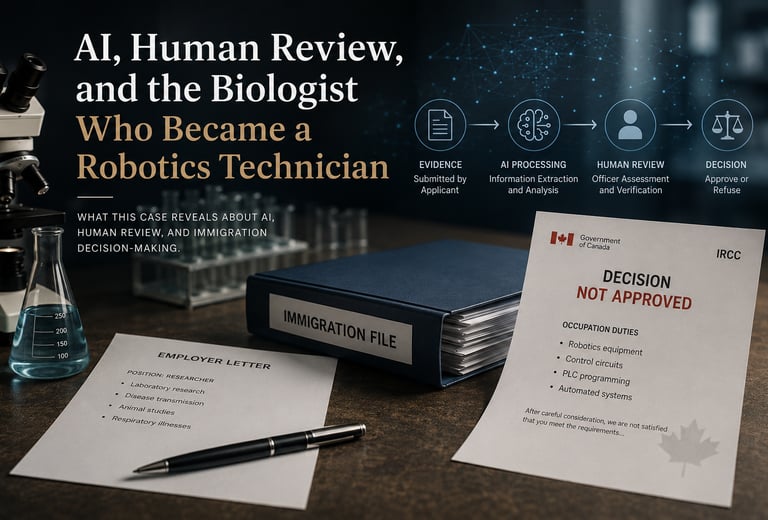
Note: This case was reported in the Toronto Star and discussed on the Canadian Immigration Podcast. The account below reflects those public reports.
A few weeks ago, I came across a case that perfectly illustrates a part of immigration processing that applicants rarely see.
A French researcher with a PhD from the Sorbonne was working at McMaster University studying respiratory illnesses. Her employer letter described laboratory research, disease transmission, and animal studies. Yet the refusal letter she received from IRCC discussed robotics equipment, control circuits, and PLC programming.
Somewhere between submission and decision, a biologist became a robotics technician.
The application was eventually approved after a reconsideration request, Federal Court proceedings, and media attention, but the question that stayed with us was not how the case ended. It was how an error that obvious became an official decision in the first place.
Cases like this suggest that the nature of immigration risk is changing. In the past, the primary challenge was providing sufficient evidence. Today, as AI becomes part of government administration, applicants face an additional challenge: ensuring that the evidence they submit remains accurate, recognizable, and contextually intact as it moves through increasingly automated layers of review.
The Part of Immigration Processing Applicants Never See
Most discussions about immigration focus on qualifications. We compare CRS scores, language test results, education, and work experience. Those factors matter. They are also the easiest part of the process to understand.
What receives far less attention is what happens after the documents are submitted.
Between the evidence you upload and the decision you receive sits a processing system that applicants cannot observe directly. Information is extracted, organized, compared, summarized, and reviewed. Some of those functions now involve automated tools.
IRCC maintains that officers make the final decisions. The issue raised by the robotics case is not whether a human ultimately clicked the refusal button. The issue is that information inconsistent with the applicant's actual work duties appeared in an official decision and was not corrected before the refusal was issued.
For applicants, the practical lesson is straightforward: meeting the requirements does not automatically produce the expected outcome. Your evidence must also move through the review process accurately and be interpreted as intended.
The Gap Between Policy and Practice
IRCC's public position on artificial intelligence is measured. Automated tools assist with processing. Human officers remain responsible for decisions. The principles guiding the use of these tools include transparency, accountability, and fairness.
The robotics case raises uncomfortable questions about how those principles operate in practice.
The discrepancy was not subtle. A researcher studying respiratory illnesses in a laboratory does not suddenly begin wiring industrial control panels. Yet the error survived whatever review process occurred before the refusal was issued.
Whether the mistake originated from an automated system, generative AI, human review, or some combination of these remains unclear. What is clear is that the review process failed to identify a discrepancy that should have been obvious.
I am not opposed to automation or AI. Both have the potential to improve efficiency, consistency, and processing capacity. Immigration, however, is different from many administrative functions. Decisions affect careers, families, business plans, and years of preparation. IRCC maintains that AI does not make immigration decisions and that officers remain responsible for the final determination. The robotics case does not necessarily contradict that position. It does, however, raise a different question: if automated tools influence how information is organized, summarized, or presented to decision-makers, what does meaningful human review actually look like?
What This Case Actually Reveals
Public discussion focused on artificial intelligence. That is understandable. The refusal letter included a disclosure indicating that generative AI had been used during processing.
Yet I suspect the larger lesson is not about technology.
Every decision-making system has limits. Technology can introduce mistakes. Human reviewers can miss them. Internal safeguards do not always work as intended. The important point is not identifying a single cause. It is recognizing that applicants have very little visibility into how information moves through the system once it leaves their hands.
The researcher ultimately obtained permanent residence. Many applicants facing a similar situation would not know where to begin. Some might accept the refusal without question. Others might spend valuable time trying to understand what happened while critical deadlines continue to run.
When the Decision Deserves a Second Look
Most refusal letters accurately identify a genuine issue in the application. Occasionally, however, the explanation itself deserves scrutiny.
When reviewing a refusal, the first question should not always be whether the officer reached the right conclusion. Sometimes the more important question is whether the decision accurately reflects the evidence that was actually submitted.
If a refusal appears factually inconsistent with your documents, it is worth examining the details carefully. Do the duties described in the refusal correspond to the duties in the employer letter? Does the reasoning reflect the contents of the file? Is there a discrepancy large enough that it cannot reasonably be explained as a difference of interpretation?
These questions matter because deadlines do not pause while applicants investigate what went wrong. The 15-day period for judicial review continues to apply even when a decision appears difficult to reconcile with the evidence.
The Takeaway
Most applications are processed correctly. Most decisions accurately reflect the evidence before the officer.
What makes this case noteworthy is not that an error occurred. Every system produces errors. What makes it noteworthy is that the error became visible.
For years, immigration advice focused on proving the facts: work experience, education, language ability, and qualifications. Those things remain essential. But cases like this point to a second challenge. Applicants must also understand how evidence moves through a system they cannot see.
The biologist who became a robotics technician is an unusual story. The shift it reveals in modern government decision-making is not.
This post reflects on a publicly reported case and general processing trends. It is not legal advice. Every situation is different. If you are preparing an application or have received a decision that does not appear to match your file, a structured assessment can help clarify your options.
Regulated Canadian Immigration Consultant
Member #: R515705
Mapleaves Immigration Services


©2026 All rights reserved